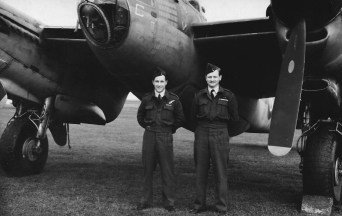
 Bill Brodie, who was 102 when he died, flew 85 bombing operations over North Africa and Western Europe. During his time flying Wellingtons with No 38 Squadron, he made a daring attack against Benghazi Harbour before flying to distract enemy defences as his colleagues made their attacks. He was awarded an immediate DFM. He later joined No 692 Squadron of the Light Night Striking Force. One night in October 1944 he was part of a small force of Mosquitos that laid mines from very low level in the Kiel Canal causing major disruption to enemy shipping. He was awarded an immediate DSO, soon followed by a DFC. He flew diversion raids over German cities and attacked Berlin 18 times over period of six months.
He is photographed (right) with his navigator and their Mosquito.
To read the full obituary click HERE
 AVM Lawrence was one of the last senior RAF commanders to see service throughout the Second World War. He specialised in maritime operations and flew Blenheims on patrol over the North Sea, Catalinas and Sunderlands from Gibraltar, when he supported Operation ‘Torch’. Towards the end of the war he commanded a Liberator squadron flying from Scotland. He attacked and sank a U-boat 150 NW of Cape Wrath. His post war career included command of a Venom squadron in Germany, in charge of flying operations at the Royal Radar Establishment and co-ordinating air plans in Aden. After command of Wittering and its Victor squadrons, he was AOC Scotland and Northern Ireland. He was appointed CB, CBE and awarded the AFC.
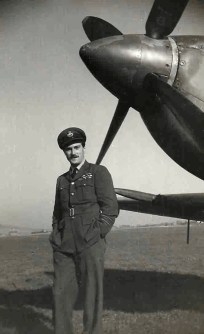 Paul Farnes was the last surviving Battle of Britain pilot to achieve ‘ace’ status during the Battle. He had joined 501 Squadron as a sergeant pilot in September 1939 flying the Hurricane. The squadron was sent to France and, after the German blitzkrieg on 10 May 1940, he was in constant action and claimed one enemy aircraft destroyed and shared in the destruction of two others. During the Battle he claimed six more enemy aircraft and in October was awarded an immediate DFM. After a period instructing fighter pilots he left for the Middle East and later commanded 229 Squadron in Malta. He served in Iraq until early 1945 before flying Spitfires and Mustangs. He remained in the RAF as a flying instructor, served in Egypt and served at Fighter Command before leaving the service in 1958. He was an ardent supporter of the Battle of Britain Memorial Trust and attended the annual reunions at Capel le Ferne until the summer before his death.
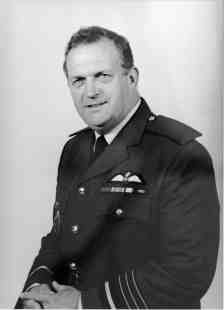 Sir Michael Stear began his flying career as a fighter pilot in 1964 flying Hunters in UK and in the Persian Gulf. After an exchange tour flying Phantoms with the USAF he commanded two RAF Phantom squadrons before converting to the Harrier. He served as the station commander at Gutersloh in West Germany before becoming the AOC of No 11 (Fighter) Group at a time when the Tornado F 3 was entering squadron service. After service in MoD he became the AOC of No 18 (Maritime) Group at the time of the first Gulf War when his Nimrods and Buccaneers deployed for operations. His final tour before retiring in 1996 was as the Deputy C-in-C Allied Forces Central Europe. A fine rugby player, he represented Cambridge University, the RAF, Combined Services and Hampshire. He played against the 1963 All Blacks. He was 81 when he died on January 5.
 John Jennings was a Cold War fighter pilot throughout his career in the RAF. At the end of WW 2 he flew Mustangs in Palestine before converting to jets, initially Vampires from Odiham. After an exchange tour with the USAF flying Sabres he served at the Central Fighter Establishment. He converted to the Hunter before taking command of the Strike Wing at RAF Khormaksar. He led many strikes during the Radfan campaign when he was awarded the DFC. As a group captain he commanded RAF Coltishall with Lightnings. After six years in NATO appointments, he retired from the RAF in 1979.
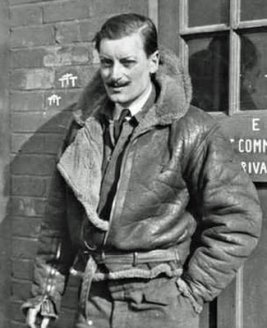 With the death of Flight Lieutenant Maurice Mounsdon aged 101, there are just three surviving Battle of Britain veterans. He joined No 56 Squadron at North Weald in June 1940 and over the next two months he destroyed two enemy fighters, probably destroyed two others and also claimed two damaged. On 31 August he was scrambled and attacked a fighter escorting a force of bombers. His Hurricane was hit from behind, set on fire and Mounsdon baled out. Badly burned about his legs and arms, he became a Guinea Pig and spent almost two years recovering. He spent the rest of the war as a flying instructor and left the RAF in 1946. After retiring as an engineer, he left for Menorca where he spent the rest of his life.
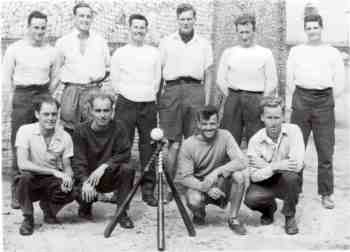 Canadian navigator Bill Paton was shot down in his 431 Squadron Wellington near Mannheim in April 1943 and sent to Stalag Luft III. During the building of the tunnels for ‘The Great Escape’ he helped disperse the waste sand . An expert baseball pitcher, he arranged matches to divert the attention of the guards and the activity on the field helped to spread the spoil dropped by the ‘penguins’ from the pouches suspended down the legs of their trousers. In late January 1945, the PoWs were forced to march west in terrible weather in an ordeal that became known as ‘The Long March’. In the photograph of the Canadian PoW’s baseball team, Paton is 3rd from the left in the back row.
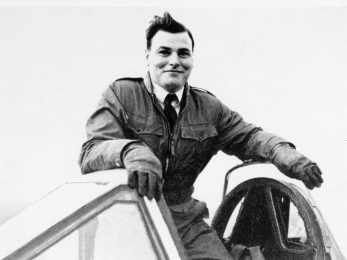 Jo Lancaster was the first man to use a British ejector seat in an emergency when he was forced to abandon his out-of-control experimental jet.He had been an apprentice at Armstrong Whitworth before going the RAF and a training as a pilot. He flew 30 bombing operations in Wellingtons with No. 40 Squadron before becoming an instructor. He returned to operations on Lancaster with 12 Squadron and was awarded the DFC. After training as a test pilot he joined Saunders Roe – where he flew the Saro SR-1 jet-powered flying boat fighter. He moved to Armstrong Whitworth and on his third flight in the AW-52 “Flying Wing”, the aircraft oscillated violently during a dive and Lancaster ejected using the Martin Baker Mk 1 seat. He continued testing fighters and later flew air survey and mapping flights for a private company. He was 100 years old when he died in August.
 Peter Taylor was a Cold War fighter pilot. Early in his career flying Hunters he was a member of the Blue Diamonds aerobatic team before a tour on No. 8 Squadron based in Aden. He saw action along the Yemeni border and flew strikes against dissident targets during the final British withdrawal from Aden in November 1967. After conversion to the Harrier he joined No. IV Squadron in Germany. He was forced to eject after a bird strike and was astonished when the Harrier flew away and climbed to 20,000 feet before crashing. He commanded No. ! Squadron and saw service in Belize and was the station commander at RAF Bruggen with four Jaguar squadrons. He retired in 1987 and worked for British Aerospace before organising the Farnborough Air Show during his time with SBAC.
 John Hart, who has died aged 102, was the last surviving Canadian Battle of Britain pilot. He joined No. 602 Squadron in September 1940 and saw action over the English Channel when he shot down a Messerschmitt Bf 109 and shared in the destruction of a Junkers 88 bomber. He went on to fly Hurricanes in Burma on ground attack sorites before taking command of No. 67 Squadron escorting bomber and airborne supply operations. In March 1945 he joined No. 112 Squadron in Italy to fly the Mustang. He took over as the CO and led formations against rail and road communications and attacked bridges in northern Italy, Yugoslavia and southern Austria. He was awarded the DFC and returned to live in Vancouver.
 GRAHAM PITCHFORK