 Gordon Mellor was the navigator of a Halifax bomber shot down over Belgium. He was helped by local farmers and eventually reached Brussels where members of the Comet Line took control and escorted him to the Spanish border. He joined a party that was taken over the Pyrenees into Spain and he eventually reached the UK. He served the rest of the war as a navigation instructor.
The photograph is the one used on his false papers in France
To read full obituary clock HERE
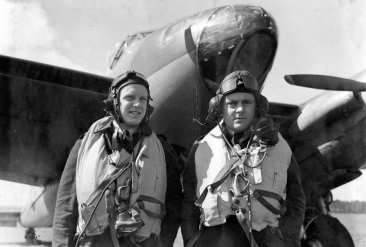 Reg Reynolds was one of the most decorated RAF pilots during World War Two earning two DSOs and two DFCs, one of only 30 airmen to do so. He led many low-level daylight attacks in Mosquitos including the longest to the Zeiss Optical Works at Jena and the attack on the Gestapo headquarters at Aarhus in Denmark. His most spectacular success was to lead four Mosquitos on the first daylight raid on Berlin when, with brilliant timing, a key address by Goring to the German nation at a mass rally was interrupted. The attack was a great propaganda coup.
 A former Halton aircraft apprentice, Ted Stocker was one of the first flight engineers who went on to complete 102 operations in heavy bombers over Europe, one of very few airmen to reach this extraordinary number. He was the only flight engineer to be awarded the DSO. Many of his operations were with the Pathfinder Force and he frequently flew with the Master Bomber. He also received the DFC. After the war he trained as a pilot and flew with Coastal Command on Lancasters and Lockheed Neptunes.
 Alfie Martin was the bomb-aimer of a Halifax bomber shot down on the French-Belgian border. He baled out and was fortunate to be sheltered by a family for six weeks and who had connections with the Comet Escape Line. He was taken by couriers to the Spanish border near St Jean de Luz where a Basque guide took him over the Pyrenees into Spain. Taken to Gibraltar he flew back to England two months after being shot down. He was awarded the DFC.
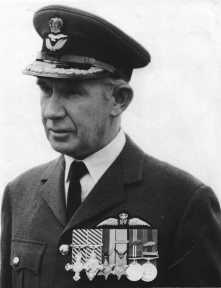 Johnny Foster flew Spitfires and Mustangs and in the latter stages of the Second World War he led formations of Mustangs escorting the Beaufighter and Mosquito Strike Wings flying from Northern Scotland to attack shipping off the Norwegian coast. After the war he commanded Meteor jet fighter squadrons and served in NATO before commanding a pilot training base and serving as the Air Attache in Rome.
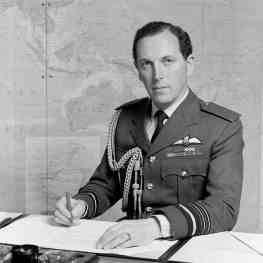 Sir Peter Terry had a long and distinguished career as a pilot and as a commander in the RAF and in NATO but will best be remembered for his role in the shooting by the SAS of three IRA terrorists in Gibraltar. At the time he was the Governor of the British territory and gave the Gibraltar police the authority to mount the security operation to apprehend the three. In 1990 he was severely wounded in a revenge attack at his home when he was hit by nine bullets fired through the window of his house in Staffordshire. The IRA claimed responsibility.
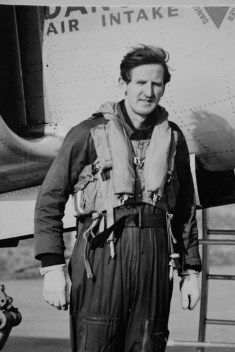 Duncan Simpson’s name will be forever linked to the Hawker Siddeley Harrier, the vertical and short take off and landing (V/STOL) ground attack aircraft. A former RAF fighter pilot he was involved in testing the Hawker Hunter before joining the V/STOL programme in its earliest days when he flew the P.1127 and then the Kestrel. Later, as the chief test pilot, he shepherded the Hawk advanced training aircraft from the drawing board, made its first flight and saw it into service. It has been the mount of the RAF’s Red Arrows and continues to be in RAF service after 40 years. He was awarded the OBE and many other prestigious awards for his services as a test pilot.
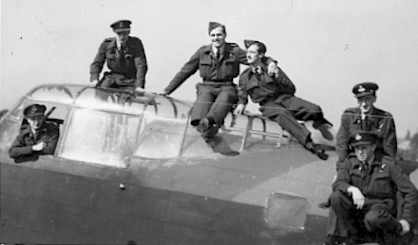 Philip Brentnall led a small force of Stirling bombers on the eve of D-Day. Their task was to fly a complicated pattern whilst dispersing ‘window’ to give the impression that a fleet of ships was sailing towards the Pas de Calais whilst the real invasion force was approaching Normandy. The ‘ghost fleet’ was successful and Brentnall received the DFC. Post war he had a long career with BOAC and then British Airways where he developed innovative ideas for pilot training eventually rising to be BA’s Fleet Training Manger.
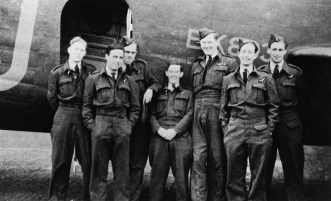 Squadron Leader Geoff Rothwell was the pilot of a Stirling and had just dropped two SOE Dutch agents when his aircraft hit a balloon cable and he crash landed on Texel Island. He was captured and spent the last year of the war as a POW. It had been his 71st operation having previously completed bombing tours on Wellingtons and Stirlings. He was twice awarded the DFC.
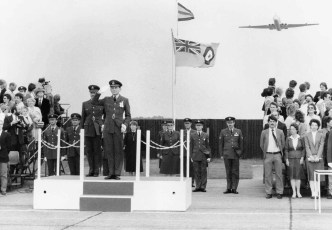 AVM Emmerson was one of the RAF’s most experienced maritime patrol airmen when he was appointed to command the Nimrod Mark 2 detachment sent to Ascension Island to fly operations during the Falkland’s War of 1982. He flew ten long-range sorties in support of the Task Force and to gather intelligence. He was awarded an AFC. His distinguished career included commanding No. 206 Squadron and RAF Kinloss in Scotland and serving as the Chief of Staff of No. 18 (Maritime) Group.
 GRAHAM PITCHFORK