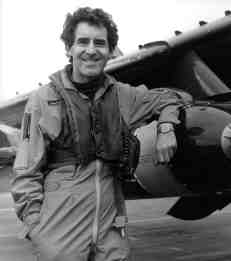
 John Farley served in the RAF as a fighter pilot before attending the Empire Test Pilots’ School. He was posted to RAE Bedford where he flew experimental jets including the Hawker P 1127, the forerunner of the Harrier V/STOL ground attack fighter. He joined Hawker Siddeley in 1967 and rose to become the chief test pilot. Throughout his 19 years with the company (later part of British Aerospace) he concentrated on the development of the Harrier and Sea Harrier and played a key role in obtaining export orders, in particular to the US Marine Corps. He was awarded the AFC and appointed OBE.
To read full obituary click HERE
 Alastair Mackie, who has died aged 95, earned two DFCs during the Second World War. The first as a bomber pilot in the Middle East when he was barely 20 years old, and the second over Arnhem whilst delivering crucial supplies to the beleaguered 1st British Airborne Division. Post war he commanded the second Vulcan bomber squadron to form and, whilst enjoying the flying the aircraft, he became increasingly disillusioned with British defence policy and the need for an independent nuclear deterrent. This view was reinforced during later appointments at the heart of MoD policy making and he chose to retire aged 45. He served at the Middle Temple and the Health Education Council and became a prominent and active member of CND and served as its long-serving vice-president.
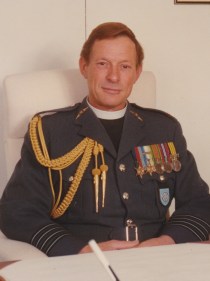 The Reverend Group Captain Donald Wallace, who has died aged 92, served in the Royal Navy as an Asdic operator, initially during the Battle of the Atlantic and then in support of D-Day. During the autumn of 1944 he sailed on the Arctic Convoys to Murmansk. Ordained after the war, he served in Aden, Kenya, Cyprus and Germany before becoming the assistant principal chaplain at HQ Support Command. He was appointed a Queen’s Honorary Chaplain in 1977. He received the Russian Ushakov Medal and the French Government awarded him the Legion d’Honneur.
 Group Captain Caryl Gordon was an RAF flying instructor who taught the Duke of Edinburgh to fly. Trained to fly in Canada, Gordon returned to England in the closing months of the Second World War. After flying transport aircraft he became an expert flying instructor and formation aerobatic pilot. After almost three years as the Duke’s personal pilot, Gordon commanded night fighter squadrons and was the Air Attache in Argentina.
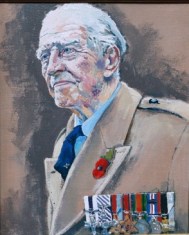 Artillery officer Ted Maslen-Jones was one of only two AOP pilots to be awarded the MC and the DFC during the Second World War. He flew with No. 656 (AOP) Squadron during the Burma campaign arriving in the Arakan in early 1944. He supported operations by the 14th Army as it crossed the Chindwin and headed towards Rangoon flying many sorties ranging the guns of the 20th and 25th Indian Divisions. The citation for his DFC mentioned his ‘unfailing courage’ and the one for his MC awarded nine months later referred to his ‘continuous gallantry and devotion to duty’. In addition, he was twice mentioned-in-despatches.
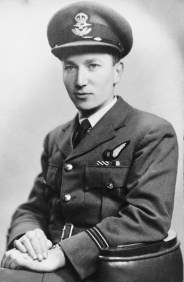 Humphrey Phillips joined the RAF as a fitter and was one of the first to volunteer for the new aircrew trade of flight engineer. After a period instructing he joined No. 626 Squadron and flew 27 operations in Lancasters including nine to Berlin during the winter of 1943-44 during what became known as the Battle of Berlin. He was awarded the DFC and was twice mentioned in despatches.
 MRAF Sir Keith Williamson began his RAF career in 1945 as an aircraft apprentice and rose to become the Chief of the Air Staff (CAS); the only apprentice to reach the top post. He trained as a fighter pilot and after a tour on Vampires in Germany, he flew with Meteors in Korea with the Royal Australian Air Force. He flew Hunters and Lightnings before taking command of RAF Gutersloh. He served in SHAPE and was the Air C-in-C of Support Command before taking command of Strike Command. He became the CAS just after the Falkland’s War and the RAF’s role in the South Atlantic occupied much of his time. He was involved in the multi-national discussions to develop the European Fighter Aircraft, which became the Typhoon. He was not in favour of Michael Heseltine’s reforms in the MOD, which involved the single services losing their policy and operational requirements staffs to a centralised organisation.
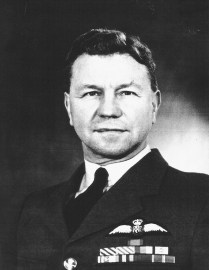 Wing Commander Cobb joined the RAF when he was 18 and trained as a pilot. Most of his operational flying was on the Wellington, initially on bombing sorties before carrying out many more on night attacks against coastal shipping, for which he was awarded the DSO and the DFC. After the war he became a test pilot, initially at Farnborough and then at Boscombe Down. He was awarded the AFC . During a tour in Malaya he played a significant role in the creation of the Malayan Air Force and he was decorated by the Malayan Government. After retiring he continued to fly, mainly on crop spraying activities.
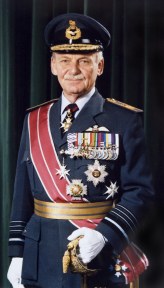 A former Cranwell cadet, Sir Peter Le Cheminant had considerable wartime experience as a medium bomber pilot in North Africa and Italy earning a DFC. He added a Bar to his award during the Korean War when he commanded a Sunderland squadron. As a group captain he commanded RAF Geilenkirchen one of four RAF strike airfields in Germany before he moved to MoD to fill the first of a number of key staff and command posts, which included international appointments with CENTO and NATO. In retirement he became the first Guernseyman to be appointed Lieutenant Governor of the island. He died aged 97.
 AVM Deryck Stapleton has died aged 100. He began his flying career in bi-plane bombers and towards the end of his service he took a Vulcan bomber on a round-the-world trip. He was awarded the DFC whilst serving with No. 14 Squadron in the Middle East and in Eritrea where he flew the Wellesley and the Blenheim. He commanded a Bomber Wing in the Balkan Air Force. In the post war RAF he commanded jet fighter bases in the UK and in Germany. He was appointed AOC No. 1 (Bomber) Group when his Vulcan bombers carried the UK’s strategic nuclear deterrent.
 GRAHAM PITCHFORK