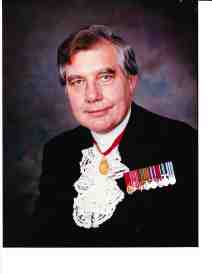
 Bill Beaumont was the navigator of a Liberator bomber tasked on a mercy mission to drop supplies to remote POW camps in Burma and Thailand. Shortly after taking off the engines failed and the crew baled out over the Ganges Delta. Beaumont spent four days in the jungle before being rescued. He later served in the fighter control branch of the R Aux AF and was Speaker’s Secretary in the House of Commons.
To read full obituary click HERE
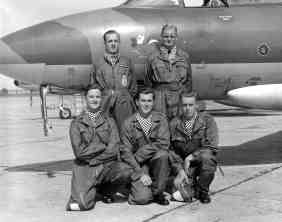 Sir Peter Bairsto was a highly regarded fighter pilot flying the Hunter in the 1950s. He led No. 43 Squadron’s aerobatic team, ‘The Fighting Cocks’ and then commanded No. 66 Squadron when it was judged to be the best fighter squadron in the RAF. He later served in Cyprus before commanding RAF Honington, the home of three Buccaneer squadrons. Although new to the maritime-attack role, he flew regularly and was appointed CBE at the end of his tour. In his later career he was Air Officer Training, the Air Commander of the Northern Maritime Region and retired after being the Deputy Commander-in-Chief of RAF Strike Command.
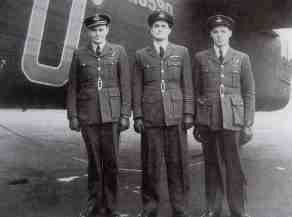 Ronnie Buckland was the pilot of a Halifax bomber when his life was saved by the cigarette case in his pocket. On the bombing run to the target, a piece of shrapnel from exploding anti-aircraft fire pierced the aircraft and hit him in the chest. Despite his wounds and bouts of unconsciousness, and with the aid of his crew, he managed to return to the UK and make a crash landing in Essex. He was awarded an immediate DFC. Two months later he returned to flying to complete 35 bombing operations. Buckland is in the centre of the photograph.
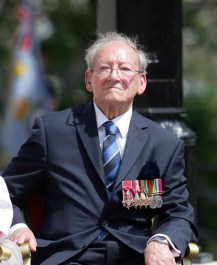 Doug Radcliffe flew as a WOP/AG in Wellingtons during the Second World War. Flying in North Africa and Italy, he completed 30 bombing operations. He will best be remembered for his devoted service as the Bomber Command Association Secretary, a post he held for over 30 years and for which he was appointed MBE. He made a significant contribution to the establishment of the Bomber Command Memorial in Green Park, which was dedicated by HM The Queen in 2012.
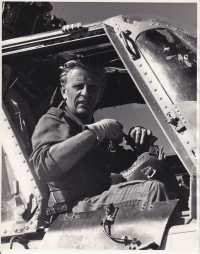 Alek Tarwid had an adventurous journey from his native Poland before arriving in the UK to join the RAF. Trained as a pilot near the end of the war, he flew Meteors and Hunters before transferring to helicopters flying on operations in Malaysia, Northern Ireland and Oman. He played a key role flying Wessex helicopters in support of the SAS during Operation Hornbeam. He was appointed MBE and decorated by the Sultan of Oman.
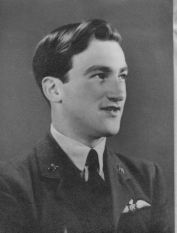 Nigel Rose flew Spitfires during the Battle of Britain and is one of the last survivors of ‘The Few’. Flying from Westhampnett near Tangmere, he accounted for at least two, and probably a third, enemy aircraft at the height of the Battle. He spent the later years of the war as a fighter and weapons instructor.
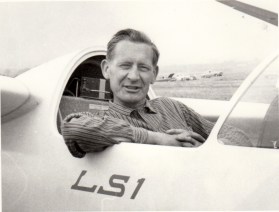 David Ince flew many operations in Typhoon fighter bombers in the period immediately after D-Day. He carried out many ground-attack sorties against German Panzer troops and motor transports. By early 1945 his squadron had moved to Holland to attack targets in Germany. He was awarded the DFC. After the war he worked in the aircraft industry and became a champion glider pilot at national level and test pilot. He established a number of records.
 Jack Perry was one of the last surviving members of the ‘Guinea Pig Club’, the organisation established in 1941 for badly burned airman who were treated by the pioneering plastic surgeon Sir Archie McIndoe. Perry suffered 80% burns to his face, ears and hands when his halifax bomber crashed in flames in 1944. Over the next two years he underwent 30 operations. In later life he became the social secretary of the club and inspired his colleagues and those who suffered in later conflicts. For his work he was appointed MBE.
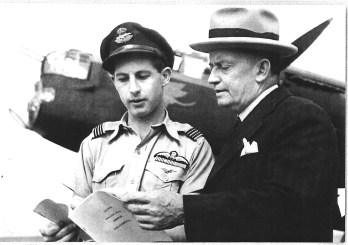 Australian Peter Isaacson completed two tours as a bomber pilot, the second with the Pathfinder Force flying Lancasters. He was awarded the DFC and the DFM. After 45 operations, he and his all-Australian crew flew a Lancaster to Australia where they gave many displays to raise war bonds. On one sortie, Isaacson flew his Lancaster under the Sydney Harbour bridge. He was also awarded the AFC. The photograph shows him with Australia’s Deputy Prime Minister.
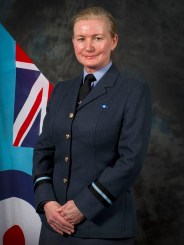 Jayne Millington was an expert on air defence operations and battlespace air management. She was part of the THRUST land speed world record event and she masterminded and commanded the air defence measures set up for the 2012 Olympics. She was seen by many as a trailblazer fort women in the RAF. She died of cancer whilst serving as the United Kingdom National Representative at Supreme Headquarters Allied Powers Europe (SHAPE).
 GRAHAM PITCHFORK