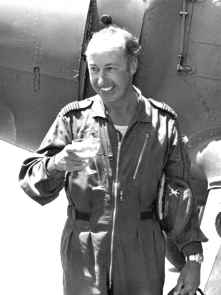
 Air Vice-Marshal Les Phipps was a fighter pilot who flew most of the post-war jets. He was a pilot attack instructor and he served at the Central Fighter Establishment and later commanded a Lightning squadron. He gained a great deal of experience overseas serving in Jordan, Malta, Borneo and Oman seeing action in the latter two. He commanded the Sultan of Oman’s Air Force during the Dhofar campaign and he also spent a year attached to the Royal Saudi Air Force. After a series of senior RAF appointments, he retired to work in the British aircraft industry. He was awarded the AFC and was appointed CB .
To read full obituary click HERE
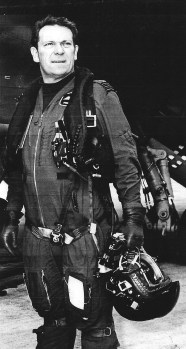 Fred Trowern was a very experienced fighter ground attack pilot who played an important role during the Falkland’s War of 1982. He was the air staff officer appointed to the Land Force Commander (Maj Gen J. Moore RM). On arrival in the islands he transferred to HMS Fearless in San Carlos Water, ‘ bomb alley’, and advised on the use of RAF assets and on offensive support operations in particular. He went ashore to Goose Green and finished in Stanley at the time of the Argentinian surrender. He was appointed OBE.
 Air Commodore ‘Dusty’ Miller was awarded the DFC after completing a tour of operations flying the Beaufighter on anti-shipping patrols in the Adriatic. Based on the east coast of Italy, he attacked barges and re-supply vessels as they endeavoured to support the retreating German army. After the war, Miller flew fighters and was one of the first pilots to use an ejector seat when he baled out of a Meteor. As a wing commander he joined the V-Force and commanded a Valiant squadron before becoming the station commander at Finningley. He retired in 1969 to go into the building industry.
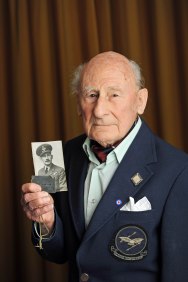 A bomber air observer shot down in June 1941, Jack Lyon was one of the last survivors to take part in the Great Escape from Stalag Luft III in March 1944. He had been a ‘stooge’ monitoring the movements of the German ‘ferrets’ who sought to discover escape plans. Lyon was given a place for the final escape and was allocated No. 89. He was waiting and preparing to enter the tunnel entrance in Hut 104 when a shot rang out signalling the escape attempt had been discovered. With others who were waiting he hastily destroyed any papers, equipment and escape material. His death occurred a few days before the 75th Anniversary of the breakout, which cost the lives of 50 of the 76 who escaped.
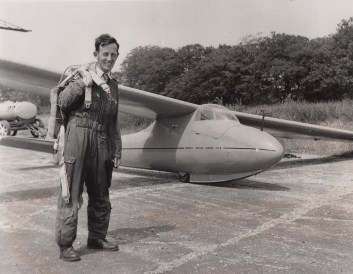 Derek Piggott served in the RAF as a pilot in the late stages of the war and in the years that followed until 1953. He became a world renowned instructor on gliders and some of his books on instructing remain the authoritative source. He was an outstanding pilot and created some national height records in early generation gliders. He was also a highly-regarded experimental and stunt pilot in films including the Blue Max, Those Magnificent Men in Their Flying Machines and Chitty, Chitty Bang, Bang amongst others. In November 1961 he made the first British unaided take-off and human-powered flight in an aircraft built by students at Southampton University. He was appointed MBE and received a number of prestigious aviation awards.
 David Hawkins rose from a National Service gunner in the RAF Regiment to become the Commandant General of the Regiment. He later became Yeoman Usher of the Black Rod and Gentleman Usher to the Queen. After he was commissioned he served with RAF Regiment Light Anti-Aircraft squadrons in Cyprus and in Singapore. After a period as ADC to the Chief of Air Staff he served at Cranwell and then commanded a squadron at Catterick when he also deployed to Northern Ireland for security duties. He commanded the Queen’s Colour Squadron and, in addition to his ceremonial duties, he and some members appeared on Bruce Forsyth’s Generation Game when they gave a display of immaculate silent arms drill movements. He commanded the RAF Regiment Depot at Catterick, served in NATO and then in the MOD when he was the Commandant General. He was appointed CB and MBE.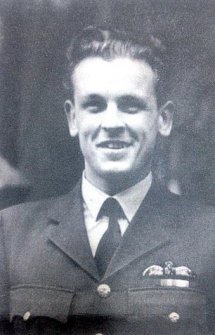
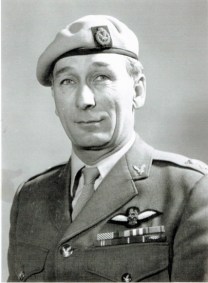 Ken Mead flew gliders on D-Day and at Arnhem where he was wounded and captured. After the war he qualified as an AOP pilot flying Austers. He saw service during the Malayan Emergency when he carried out reconnaissance sorties, target marking and leaflet dropping. He was awarded the DFM. He converted to helicopters and played a key role in the rescue of school children lost on Dartmoor in 1961. After qualifying as a flying instructor he spent many years as a standards officer before becoming a senior examinations officer on Lynx and Gazelle helicopters. He amassed 7,830 hours flying time, and was appointed OBE.
 Tim Elkington was 19 years old when he fought in the Battle of Britain as a Hurricane pilot with No. 1 Squadron. He shot down one aircraft, probably a second and damaged a third before he was wounded. He was one of the pilots of 151 Wing that went to Russia to provide protection for the Arctic Convoys and the port of Murmansk. He was a Hurricat pilot on CAM ships and later flew Typhoons in the air defence role. After operations in Burma he helped form the Air Fighting Development Unit in India. Post war he flew Shackletons during Operation Grapple – the UK’s H-Bomb test at Christmas Island and was an instructor at CFS. He died aged 98.
 This month’s edition of Flypast pays tribute to one of the country’s finest pilots and a true gentleman – the legendary Neville Duke, fighter ace and test pilot. Ken Ellis and I trace his highly successful career as a fighter pilot in the skies over UK and in the Middle East and as a test pilot with Hawkers. One of the RAF’s top-scoring ‘Aces’ with twenty-seven confirmed victories and awarded the DSO and DFC & 2 Bars, he was one of the RAF’s most highly decorated fighter pilots. After leaving the RAF he became one of the best known test pilots in the world and will always be permanently associated with the beautiful Hawker Hunter and his displays at the Farnborough Air Shows.
 GRAHAM PITCHFORK